Why the AI Revolution Hasn't Hit Game Development Yet — And Why It's Coming Next
In his latest video, Why Games Now Take 6+ Years To Make, game development reporter Jason Schreier talks about why it takes current gen games up to and over 6 years to develop.
This got me curious.
AI has revolutionized programming!
Simple yet impressive demo games get built by a single prompt in under 10 minutes.
I myself have recreated Risk using AI in a day. (Source code)
I still remember slaving away day and night for 2 weeks, over 5 years ago, to bring Q3DM17 The Longest Yard into the browser using Three.js. (Demo / Source code)
Then recently I tried my luck with an always solvable Yukon Solitaire, where I cut my teeth on my first Rust project to find solvable boards.
I told the same to Claude Code and it implemented a solution that was better and faster in 3 prompts.
Yet still, Jason Schreier, knowing all of this current development full well, releases the above video. It's even a follow-up to his video from 4 days ago titled "Why Video Games Cost So Much To Make".
How is that possible? Shouldn't video games get cheaper and faster to produce, now that we live in "The Agentic Era"?
Well the answer is actually pretty simple:
What did we get so far from AI?
- Complete song generators
- Picture generators
- Video generators
- Text generators
- Code generators
- Text to Speech
- Speech to Text
What do games need?
- Sound effects and music that dynamically adapts to the action
- Textures rather than complete pictures
- 3D engines rather than video
- Dialogue trees with branching conversation options
- Quests and storylines
- 3D models and levels
- Animations
- QA
So the simple answer is that large AI companies focused on the more common use cases first:
- Large detailed images
- Crazy ideas come to life videos
- Entire genre songs
- Chat and text to write your emails
- Code generators for the everyday software engineer
- Text to speech so we can finally listen to The Catcher in the Rye
- Speech to Text so we can get the text of a Sean Carroll AMA video and skip to the parts we care about
Ok, got that. So when will these AI companies focus on game development and fix Starfield?
Basically now. In internal teams, this has been given as the next frontier.
Keep in mind that the games industry dwarfs the movie business.
- The global video game industry generates roughly $190–250 billion per year, depending on the estimate and what is included (games, mobile, subscriptions, etc.).
- Global movie box office revenue is usually around $30–40 billion per year.
- Mobile gaming alone generates over $100 billion annually, making it larger than many entire entertainment sectors by itself.
Some examples that show the scale:
- Grand Theft Auto V has sold over 200 million copies and generated billions of dollars in revenue over its lifetime.
- Fortnite became such a cultural force that it hosted virtual concerts with millions of simultaneous viewers.
- The delay of Grand Theft Auto VI was estimated by analysts to affect industry revenue by $2.7 billion in a single year.
- The expectations for Grand Theft Auto VI are honestly on a scale the industry has never seen before. Some analysts estimate around $1 billion before release from pre-orders alone, $2–3 billion in its launch period. Market research firm DFC estimated roughly $3 billion in total sales during the first year, including pre-orders. For comparison, Grand Theft Auto V made about $1 billion in 3 days when it launched in 2013.
These are numbers large AI companies such as OpenAI, Anthropic, Google, Microsoft, Meta and Amazon won't ignore much longer.
Keep in mind that money maker Nvidia even started as a gaming hardware company. It would be more than natural for Nvidia to come full circle and provide the basis for AI generated games.
Amazon has the hardware and the media experience with gaming they need to go all in on this. They got bitten especially hard with exactly the problems Schreier describes in his videos, with their games New World and Crucible.
I won't talk much about Meta in this context, because… well we all know why. 🙂 Holy shit Zuck, get your act together man!
Google had an interesting experience in the world of gaming with Google Stadia — I still have 2 controllers lying around here somewhere. I loved the idea, but holy cow, having to buy the games again — how did that slip through in the business plan meetings?
In any case, Google is no stranger to the world of gaming. Yeah, they paid dearly for great tech that got destroyed by a stupid business plan, but who says they won't strike again given a good business plan. And there is one. At the very least Google will generate the hot mobile game of the month very soon. Why pay creators if you can gen it?
Tell an AI your game idea and out pops your game.
You think I'm crazy?
I guarantee this is coming next and right freaking soon.
Will it be one prompt to make a great game?
Of course not. It will take days and days of prompting different areas, different characters, and different dialogue trees to make a great game. But it will be possible. Mark my words. This is the next big thing.
Speculation about what GTA6 will cost customers is running wild. This will be the last major AAAA game to be made in the traditional way. Some people in the game industry hope for $100 just so there is a new standard and they can sell their games for $80 or $90. Imagine the revenue margins games would make if they are completely AI generated. These are revenue numbers no one will be able to ignore.
If OpenAI ever hopes to make their investors money back, this is the way.
What will it take to get there?
AI companies need to shift image generation to texture generation. The only challenge there is to figure out how to do the UV mapping onto 3D models.
This is trivial and as far as I know already solved.
AI companies need to shift to 3D model generation.
This is trivial and already solved — see Microsoft's TRELLIS.2 blog post and demo.
AI companies need to generate dialogue trees with branching conversation options based on the overall story of the game.
This is trivial and already solved — shout out to Friends and Fables.
AI companies need to shift to 3D world generation.
This is the only area where more research needs to be done, and where currently a heavy reliance on the particular 3D engine exists — for example Unreal Engine, which charges royalties for large games. So this will need to be heavily investigated.
One interesting aspect of this engine thing is the recent trend of rewriting an existing library in a new language using AI. Famous examples include the rewrite of Next.js by Cloudflare, the rewrite of Bun from Zig to Rust, (Jarred Sumner's thoughts on the Bun Rust Rewrite), (Andrew Kelley's thoughts on the Bun Rust Rewrite), chardet, git itself and Postgres.
Here is a nice essay on the topic: AI And The Ship of Theseus.
Someone even made a meme homepage, malus.sh, where you can upload a manifest file and it rewrites the entire codebase in a new language using AI and replaces the restrictive GPL license with one of your choice.
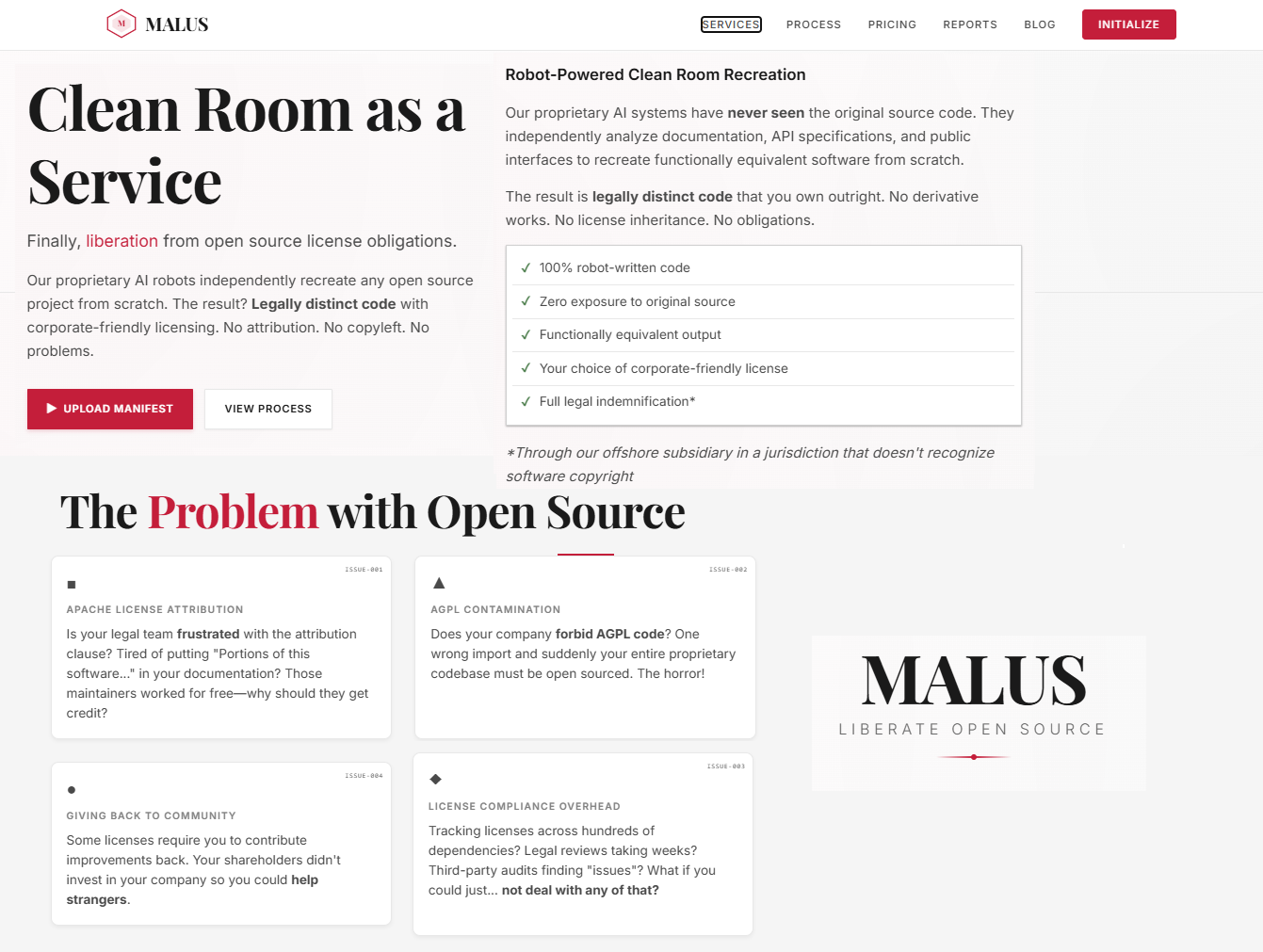
What happens if someone decides to rewrite Unreal Engine using the Zig or Carbon programming language and releases it under the MIT license? I bet Epic Games didn't think about that scenario when they "open sourced" Unreal Engine in 2015.
OpenAI, Meta, Amazon, Microsoft, Anthropic and Google will become AI gaming companies very soon. The money is there, the incentives are there, and the tech can easily be adapted.
The next great game won't be made. It'll be prompted.